
Cape Town is a city of many languages, accents and social histories, and that shows up in the way people speak. If you are visiting, learning a little Cape Town slang can help you follow conversations, understand signs and menus, and hear the city the way locals do.
This is not a dictionary of every expression used in the Mother City. It is a practical guide to the words you are most likely to hear, the cultural context behind them, and the differences between everyday South African English, Afrikaans influence, and Kaaps — a rich Cape variety of Afrikaans associated especially with communities in Cape Town.
The most useful approach is simple: listen first, use terms carefully, and remember that language in Cape Town is not a novelty. It is part of people’s identity, history and daily life.
Introduction to Cape Town’s Linguistic Melting Pot
Cape Town’s speech reflects the city’s layered history. English, Afrikaans and Kaaps all coexist, and many expressions cross easily between them. Some words are widely used across South Africa. Others are more strongly associated with Cape Town or with the Cape Flats and surrounding communities. In practice, locals often move between languages in a single conversation.
For visitors, that means a phrase may be familiar but pronounced differently, used in a slightly different way, or carry more local character than a standard dictionary definition suggests. A good example is lekker, which can mean “nice”, “good”, “tasty” or simply express approval. Another is robot, which in South African English means a traffic light.
Understanding the lingo is useful, but it is even more useful to understand the tone. Some expressions are casual and friendly. Others are deeply tied to community history, and should be treated with care rather than copied for effect.
Essential Cape Town Slang Every Visitor Should Know
Where to stay: Seegeluk — View Seegeluk
These are among the most common and practical words you may hear in Cape Town.
- lekker — good, nice, pleasant, tasty, or enjoyable. It can describe food, a place, a plan or a person’s mood.
- aweh — a casual greeting or acknowledgement, similar to “hey”, “cool”, or “all good”. Usage varies by context and community.
- jol — a party, good time, or lively social outing.
- braai — a barbecue, but in South Africa it is also a social ritual rather than just a cooking method.
- robot — traffic light.
- just now — sometime later, not necessarily immediately.
- now-now — soon, but not right this second.
- howzit — a casual greeting meaning “how are you?” or “how’s it going?”
- sharp / shaaaap — okay, cool, nice, understood.
- eish — an exclamation used for surprise, frustration, sympathy or concern.
Not every term is uniquely Cape Town-specific, but this is the vocabulary that most often helps visitors decode what they are hearing.
What these words sound like in context
Here are a few simple examples of how the expressions may be used:
- “That breakfast was lekker.” — The meal was good.
- “We are going for a jol tonight.” — We are going out for a fun night.
- “Turn left at the robot.” — Turn left at the traffic light.
- “I’ll do it now-now.” — I’ll do it soon, but not immediately.
- “Aweh, bru.” — A casual friendly greeting.
As a traveller, it is best to recognise these phrases before trying to use them. That way you can follow the flow without sounding as though you are performing the language.
Navigating Daily Life: Directions, Transport, and Time
Some of the most practical Cape Town expressions relate to time, directions and getting around. These are especially useful if you are chatting with a driver, asking for help, or following local conversation.
Time expressions that confuse visitors
South Africans often use time words more loosely than visitors expect.
- now can mean later, depending on context.
- now-now usually means soon, but not immediately.
- just now can mean in a little while, or even after some delay.
These are not precise schedule promises. If you need accuracy, it is better to ask directly: “In ten minutes?” or “What time exactly?”
Transport and street vocabulary
You may also hear terms linked to local travel and everyday navigation:
- robot — traffic light
- taxi — in everyday speech, this can refer to minibus taxis rather than a metered cab
- baan — in some usage, a route or lane; context matters
- berg — mountain
If you are unsure, ask for clarification politely. Cape Town residents are often used to helping visitors, but it is far better to ask a plain question than to guess based on slang alone.
Menu language can also surprise travellers. A braai menu may use words such as boerewors (spiced sausage), sosatie (skewered meat), or pap (a maize dish). In a restaurant or market, these are part of the city’s food culture rather than slang, but they are often encountered in the same conversational setting.
Food, Socialising, and Going Out
Much of Cape Town slang is easiest to understand when people are talking about food, friends and plans. This is where the language feels most relaxed and expressive.
Braai is the best-known example. It is not just “having a barbecue”; it is a social event, often shaped around family, friends, music and unhurried conversation. If someone invites you to a braai, they are usually inviting you into a social occasion, not simply offering grilled meat.
Jol is another term worth knowing. It suggests going out for fun, dancing, celebrating or simply having a good time. Depending on the group, it can sound playful, energetic or slightly nostalgic.
Lekker appears everywhere: a lekker coffee, a lekker beach day, a lekker vibe. It is one of the safest words for a visitor to recognise, because you will hear it in many contexts.
Some other useful casual expressions include:
- bru — mate, bro, friend
- china — mate or friend in some circles
- vibe — mood, atmosphere, energy
- chilled — relaxed, easy-going
It is worth remembering that not everyone uses these terms in the same way. The meaning can shift depending on age, neighbourhood, language group and social setting.
A Deeper Dive: The Roots of Kaaps and Local History
To understand Cape Town slang properly, you need to look beyond the words themselves. A great deal of local speech is shaped by Kaaps, a variety of Afrikaans historically associated with Cape communities, especially in the Cape Peninsula and Cape Flats. Kaaps is not “broken” Afrikaans. It is a living language variety with its own grammar, pronunciation, vocabulary and cultural significance.
Kaaps developed in a multilingual environment influenced by Dutch, Malay, Arabic, indigenous African languages, and later English. Cape Town’s history as a port city created conditions in which languages mixed, adapted and evolved. This is one reason the city’s everyday speech sounds distinctive even when it overlaps with broader South African slang.
Some expressions that visitors hear as “slang” may actually belong to a longer cultural tradition. Others are newer urban terms that circulate through music, neighbourhood speech and social media. In both cases, language is doing more than conveying meaning: it is marking identity, belonging and shared history.
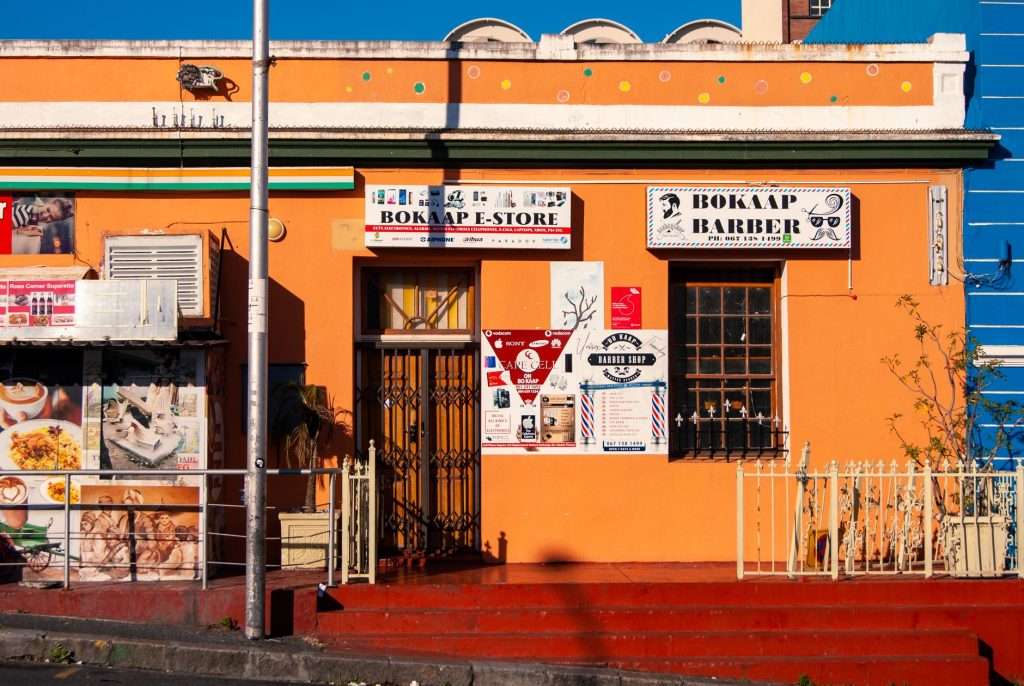
The Bo-Kaap is often mentioned in discussions of Cape language and culture, but it is important not to reduce the area or its people to a linguistic stereotype. Likewise, the Cape Flats contains many communities and speech styles; it is not a single voice. A respectful traveller should treat these places as living neighbourhoods, not as costume backdrops for “authentic slang”.
South African slang versus Cape Town-specific lingo
There is overlap between general South African slang and what people call Cape Town lingo, but the difference lies in usage, cadence and cultural setting. Some terms, like howzit, are widely understood nationally. Others, like certain Kaaps-inflected expressions or local pronunciation patterns, may feel more distinctly Cape.
In practical terms:
- General South African slang is likely to be understood across the country.
- Cape Town slang may reflect local pronunciation, Kaaps influence, and social context more strongly.
- Community-specific language should be approached with even more care, because meaning and tone can be tied closely to identity.
Tips for Using Local Lingo Respectfully
If you want to engage with Cape Town slang in a way that feels natural rather than forced, these guidelines will help.
- Listen before you copy. Hearing how a word is used matters more than memorising its dictionary meaning.
- Use simple terms confidently. Words like lekker, howzit and robot are widely understood and relatively safe to recognise.
- Avoid putting on an accent. The issue is usually not the word itself, but the performance around it.
- Do not treat Kaaps as a joke. It is a real language variety with deep cultural roots.
- Ask if you are unsure. Most people would rather explain a phrase than hear it misused.
The safest rule is to mirror local speech lightly, not imitate it. A few well-placed words are enough to show interest. More than that can quickly feel inauthentic.
If you want to understand Cape Town better, language is one of the best starting points. It reveals how the city thinks, remembers and relates. Used with respect, even a small vocabulary can make conversations warmer and everyday life easier to navigate.
So the next time someone says the coffee is lekker, suggests a jol, or tells you they will be there just now, you will know how to read the room.